Defining Concepts:
Race
Race is a socially-constructed identity based on geographic, historical, political, economic, social and cultural factors, as well as physical traits, even though none of these can legitimately be used to classify groups of people. Race is a social identity construct that is attributed a meaning of “natural” or “biological” category in a social/economic context.
Racism
Any individual action or institutional practice which causes prejudice, hostility, discrimination and/or violence, consciously or unconsciously, against persons of a specific race or ethnic group.
Systemic racism
Also known as institutional racism, refers to the ways that whiteness and white superiority become embedded in policies and processes of an institution, resulting in a system that advantages white people and disadvantages Black, Indigenous, and People of Colour (BIPOC)/IBPOC.
Privilege
Unearned power, benefits, advantages, access and/or opportunities based on membership in a dominant group.
Institutional or Systemic Racism
Consists of patterns of behaviour, policies or practices that are part of the social or administrative structures of an organization, and which create or perpetuate a position of relative disadvantage for racialized persons. Systemic racism could be a feature of organizations or could be present in all aspects of society such employment, education or health services. These are not necessarily put in place intentionally. They appear neutral on the surface but, nevertheless, have an exclusionary impact on racialized persons, often with differential discrimination impacts emerging from the intersections of other identity factors.
Anti-Racism
The conscious opposition to racist theories, attitudes and actions. Anti-racism is not just about being against the idea of racism. It is also about taking active steps to fight against it.
Ally
A person who recognizes their own privilege, commits to learning about the challenges of a person or a group of people experiencing discrimination, and works in solidarity with them to fight against oppression. An ally does not seek acknowledgement or call themselves an ally. Rather, their involvement and commitment are recognized by members of the group they have allied with.
Colonialism
A practice of domination involving the subjugation of one people by another. Settler colonialism, such as the case of Canada, is a process whereby the colonizing population does not leave the territory, asserts ongoing sovereignty over the land, and actively seeks to assimilate Indigenous populations and extinguish their cultures, traditions and ties to the land.
White Privilege
Benefitting from unearned power, advantages, access and/or opportunities based on being white or being perceived as white. White people are defined as belonging to any of the various peoples with light-coloured skin, usually of European origin. The term has become an indicator less of skin colour and more of an unquestioning acceptance of the legacies and ongoing practices of white supremacy and colonialism.
Decolonization
A process that consists of challenging and dismantling colonial ideas, values and practices embedded in society in order to restore Indigenous ways of knowing, being and doing. Decolonization aims to shift the way Indigenous People view themselves and the way non-Indigenous People view Indigenous People.
Bias
An unconscious or mistaken predisposition, prejudice or generalization about a group of persons based on personal characteristics or stereotypes. Bias could be directed against individuals or groups; it could also be the result of cumulative processes emerging as a consequence of unintentional actions.
Discrimination
The unjust or prejudicial treatment of a person or group of people that deprives them of or limits their access to opportunities and advantages that are available to other members of society because of their race, national or ethnic origin, colour, religion, age, sex, sexual orientation, gender identity or expression, marital status, family status, genetic characteristics, or disability.
Equality
The principle of treating everyone in the same manner by ensuring they have access to the same resources and opportunities. Equality does not necessarily lead to fair outcomes since it does not consider people’s unique experiences and differing situations.
Equity
The principle of considering people’s unique experiences and differing situations, and ensuring they have access to the resources and opportunities that are necessary for them to attain just outcomes. Equity aims to create a level playing field by eliminating disparities and disproportions that are rooted in historical and contemporary injustices and oppression.
Intersectionality
The way in which people’s lives are shaped by their multiple and overlapping identities and social locations such as race, ethnicity, class, disability status, sexual orientation and gender, which, together, can produce a unique and distinct experience for that individual or group, for example, creating additional barriers, opportunities, and/or power imbalances.
Source: Government of Canada.
Tips on how to be an ally
Do you want to be an ally? Lead with these small habits:
- Listen: Hold space for colleagues to share their experiences.
- Engage: Connect with Defence Team Advisory Groups and Networks.
- Acknowledge: Recognize your own actions and seek out feedback.
- Do the work: Challenge behaviours, practices and policies that reinforce racism.
- Source: Government of Canada.
Tips on how to have courageous conversations
Start the conversation
Engaging in dialogue is the first step to understanding one another. The goal of these conversations is to raise awareness and build empathy.
Use the BRAVE framework
The build, respect, acknowledge, validate and emphasize (BRAVE) framework is a useful tool that provides strategies to explore when having courageous conversations at all levels of an organization.
- Build the intention, focus, and safety needed to have honest conversations about race.
- Respect the sensitivity of the topic while challenging people to go beyond the superficial. Everyone needs to respect each other’s boundaries.
- Acknowledge the uncomfortable realities of the past and the present.
- Validate and accept the experiences of your racially marginalized colleagues. Productive conversations require acknowledging the reality of racism and racial discrimination.
- Emphasize how your organization is prioritizing goals and measuring success around racial equity.
- Source: Government of Canada.
The Human Rights-Based Approach
The equal and inalienable rights of all human beings provide the foundation for freedom, justice and peace in the world, according to the Universal Declaration of Human Rights, adopted by the UN General Assembly in 1948.
The human rights-based approach focuses on those who are most marginalized, excluded or discriminated against. This often requires an analysis of gender norms, different forms of discrimination and power imbalances to ensure that interventions reach the most marginalized segments of the population.
A human rights-based approach also seeks to reinforce the capacities of duty bearers (usually governments) to respect, protect and guarantee these rights. It aims to address development complexities holistically, taking into consideration the connections between individuals and the systems of power or influence. And it endeavours to create dynamics of accountability.
Read more at UNFPA website.
Advocacy:
What is people-centred advocacy?
Advocacy means amplifying the voice, but the fundamental question facing activists is whose voice and
for what purpose. Across the world large numbers of people are marginalised and unheard in the corridors of power. Advocacy can work to amplify their voices, however, this aspect of advocacy is often less understood or put into practice. Advocacy is more often perceived as a systematic process of influencing public policies. Yet, while policy change is necessary, it is not sufficient to transform the structures, attitudes, and values that are at the root of societal inequities and injustice. Instead a more
people-centred approach focused on social transformation is needed (Samuel, 2002).
Characteristics of people-centred advocacy
People-centred advocacy is a set of organised actions aimed at influencing public policies, societal attitudes, and socio-political processes that enable and empower the marginalised to speak for themselves. Its purpose is social transformation through the realisation of human rights: civil, political, economic, social, and cultural. People centred advocacy is by the people, of the people, and for the people. Hence, it is the spirit of democracy that drives the very idea of people-centred advocacy (Samuel, 2002).
Read more about people centred advocacy at Samuel, J. (2002) What is people-centred advocacy? PLA Notes, 43: 9-12
SDGs
Learn more about sustainable development here
What is Community Organizing
Community organizing refers to bringing community members together and providing them with the tools to help themselves or work towards common interests. It requires determination, perseverance, a clear plan with goals, reliability, follow-through, and a willingness to compromise (Citizen Committee for New York City).
Community organizing is a process. The most critical step in community organizing is to inform and educate people on socio-political, economic, and environmental issues and encourage their participation in community development. Once people are aware of their issues and feel connected with their community, they will show their interest in the community development process, such as sharing stories, analyzing problems, developing actions, receiving training, and connecting with resources that help themselves and community members (Hasan, 2022).
Read more about community organizing at Hasan, 2022
Community engagement
Community engagement is the most crucial step in participatory community development practice. It is the step of actively working with the community to identify and address local ideas, concerns, and opportunities (Tamarack Institute, 2015). Community engagement allows community workers to involve “the public in processes that affect them and their community” (Ibid, p.1).
We can describe the community engagement approach based on seven characteristics (Tamarack Institute, 2015, p.2 )
The community determines local priorities. There is a balance between community engagement processes and creating action (Hasan, 2022).
- A broad range of people is participating and engaged.
- People are trying to solve complex issues.
- The engagement process creates vision, achieves results, and creates movement and change.
- Different sectors are involved in the process.
- There is a focus on collaboration and social inclusion.
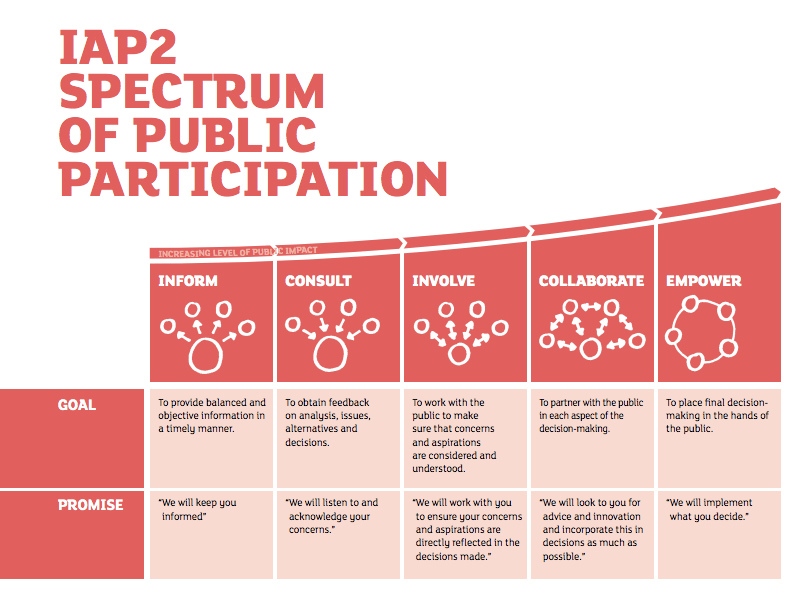
Source: IAP2 Spectrum of Public Participation by Tim Bonnemann in licensed under CC BY-NC-SA 2.0
 Together End Racism in Toronto